

Commercial Property Exposure: Finding Hidden Risks to Physical Assets
Business leaders often map the risks to their firm. Most look first at cyber threats. Some look at big swings in the economy. Others worry about delays in the supply chain. But one big risk is often missed. It is the risk to physical assets.
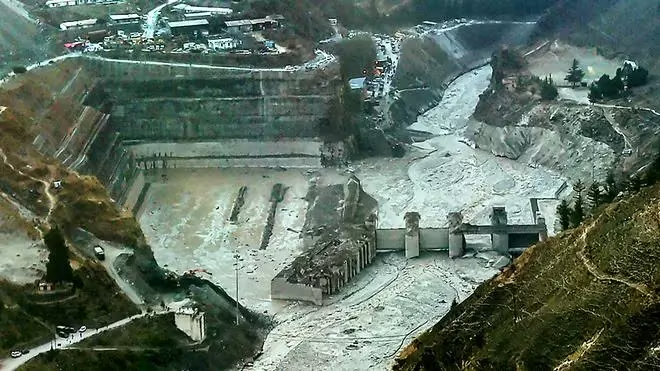
Physical assets are the things that keep your firm running each day. They include machines, buildings, and special computer gear. They also include goods in stock and upgrades made to a building. For most firms, these assets are the biggest weak spot. A fire, a flood, or a broken machine can stop work fast. It can hurt as much as a cyber-attack.
A standard commercial property insurance policy is meant to help. It is a safety net when a loss occurs. But real claims show a big gap. Risk managers think a loss is covered. The policy often says it is not. Three things cause much of this gap. First, asset values are out of date. Second, add-ons to the policy are not well understood. Third, hazards in the area are never checked. These hidden gaps often show up only after a big loss. By then, it is too late to fix them.
This article shows you where those gaps hide. It walks through the layers of physical risk in a modern workplace. It explains a costly rule called coinsurance. It also shows how lost income can follow a loss. It ends with a four-stage way to check your own site.
Hidden Weak Spots in Modern Workplaces
Physical risk goes far beyond fire or a weak wall. A modern workplace has many parts that work as one. Some are mechanical. Some are digital. Some are part of the building. To judge your risk, look at each layer. Here are the main ones.
- Special Equipment and Machines. Factories, clinics, and labs use fine machines. These have tiny electronic parts. They must be set with great care. Standard policies often treat them like plain So they may leave out arcing, which is a spark that jumps through the air. They may leave out a machine breakdown. They may even leave out a fault in the software that runs the machine.
- Power, Water, and Other Services. Harm rarely stays inside your Commercial property insurance lines. A power station far away may A city water pipe may burst. A phone line may be cut. Any of these can make a sound building useless. The building is not hurt, but you cannot work in it.
- Tenant Upgrades (TIB). Many firms rent their space. They often spend a lot to change it. They may add custom lights, sound panels, or better heat and air These are known as tenant improvements and betterments, or TIB. Lease deals and policy lists must name these upgrades. If they do not, the tenant may lose hundreds of thousands of dollars. That cash is spent and never paid back.
- Server Rooms and Tech Hardware. Server rooms and network gear face quiet risks. A small cooling fault can do A shift in humidity can do harm. A static shock can do harm too. Any of these can ruin key hardware. The outside of the building may show no sign of it.
Each layer can fail on its own. Each can also set off a chain of other losses. That is why you need to see the whole picture. A quick look at one part of your site is not enough.
Coinsurance and Property Value Traps in Commercial property insurance
One costly trap is a wrong value on your assets. It goes hand in hand with a coinsurance clause. Think of it as a deal. You agree to carry enough cover. If you do, the insurer pays your claim in full. If you do not, you share the loss. Most policies have a clear rule. You must carry cover equal to a set share of the true replacement cost value of your assets. That is often called RCV. The share is most often 80%, 90%, or 100%.
Costs have shot up in recent years. Prices have jumped. Building parts cost more. Workers are hard to find. So it costs far more now to replace a building. The same is true for special equipment. A value that was right a few years ago may be too low now. Now see what happens if your limit is too low. The limit is the most the insurer will pay. Say it is less than the share the policy needs. The insurer will then use a penalty formula on part claims. That cuts your payout by a lot. This is why values need regular checks. Prices change, and old numbers go stale.
Main Causes of Uninsured Property Losses
The data below comes from risk audits. They looked at mid-size and large work sites. They show why so many losses end up with no pay out.
Main Causes of Uninsured Commercial Property Losses (share of losses)
Wrong asset values and coinsurance penalties 38%
Utility outages and failures off site 26%
Equipment breakdown and arcing with no cover 20%
Flood, surface water, and earth movement with no cover 16%
Wrong asset values and coinsurance penalties top the list at 38%. Utility outages and off-site failures come next at 26%. Equipment breakdown and arcing with no cover make up 20%. Flood, surface water, and earth movement with no cover make up the last 16%. Note that the top cause is not a disaster. It is a gap in the math. Two more points stand out. Utility failures often start off site. Equipment faults can hide inside a building that looks fine.
Here is the math behind a coinsurance penalty. It shows two cases side by side. In both, the true value of the Commercial property insurance is $2,000,000. The policy needs cover of at least 80% of that. That is $1,600,000. In both, a loss of $400,000 takes place.
How a Value Gap Changes a Claim Payout
|
Item |
Properly Valued Asset |
Underinsured Asset |
| True replacement value | $2,000,000 | $2,000,000 |
| Required cover (80% minimum) | $1,600,000 | $1,600,000 |
| Insurance limit carried | $1,600,000 | $1,000,000 (short by $600,000) |
| Physical loss amount | $400,000 | $400,000 |
| Claim penalty ratio | 100% (fully covered) | 62.5% ($1M / $1.6M) |
| Final insurer payout (deductible not shown) |
$400,000 |
$250,000 |
Look at the second case. The owner carried only $1,000,000. The policy asked for $1,600,000. So the insurer paid just 62.5% of the loss. That is $1,000,000 divided by $1,600,000. Of the $400,000 loss, the insurer paid $250,000. The owner had to pay the other $150,000. A gap in value can shrink your claim and leave you with a big bill.
Business Interruption and Supply Chain Links
Damage rarely comes alone. When a site is wrecked, sales stop at once. But fixed costs go on. You still pay your staff. You still pay debt and rent. You still pay for software plans. A good Commercial property insurance policy must fill this gap.

Picture a small shop that loses its site to a fire. Rent is still due on the first of the month. Staff still need to be paid. Loan payments still come due. With no income, the owner must find that cash alone. This is the gap that good cover can close. To do this, pair damage cover with Business Interruption cover, or BI. Add Extra Expense cover too. Both help pay the bills while you rebuild. Extra Expense cover also helps with added costs to keep work going.
Your risk also reaches past your own walls. A key supplier may face a major loss. So may a power firm or a maker of raw goods. If that happens, your work can stop just as fast. Most firms face risks like this. Contingent Business Interruption cover, or CBI, can help. It guards your income when a key vendor or client site suffers physical harm. Without it, you could lose sales even if your own site is safe. Think of CBI as cover for trouble that starts at someone else’s site.
Checking Local Risks and Cutting Them in Commercial property insurance
At leading online portal, their team guides business owners through full risk checks. To find hidden risks, you must go past a basic insurance form. You need to visit the site. You also need to study the area around it. This work takes some time. But it costs far less than a large loss with no cover.
A good risk check has four stages. Each one helps you find weak spots before disaster hits.
- Map Your Location and Climate Risks. Study flood plains. Study zones where wildfire meets towns. Study earthquake zones. Check if city storm drains can handle heavy rain. Small local climates can bring unique Regional insurance maps may miss them. The land and weather around you shape many of your risks.
- Inspect the Site and Check Upkeep. Inspect the electric panels. Inspect the water pipes, the roof, and the fire safety gear. Make sure upkeep work is truly done. Heat imaging can help. It uses heat photos to spot hot spots inside electric It can find them long before a fire starts. A small fault found early costs far less than a big loss later.
- Review Your Lease and Building Read your lease with care. Learn who must care for the structure. Learn who must care for tenant finishes. Also check that your policy has Ordinance or Law cover. After a part loss, new building codes may force upgrades. This cover pays for them. Rules on who fixes what can differ from one lease to the next.
- Match Equipment and Special Risks to Cover. Check if your key equipment has its own Equipment Breakdown Some call this a boiler and machinery rider. It pays for sudden electric or mechanical damage. Without it, a costly machine may have no cover at all. Regular Commercial property insurance plans may not pay for this kind of harm.
Treat the care of your physical assets as a plan that grows. It should have many layers. Then a fixed policy becomes a working tool for strength in hard times. Know your true values. Know your gaps. Ask what your policy really says. Protecting your physical assets keeps your firm ready. It helps you grow, stay stable, and thrive over the long run.