

Natural Disaster Gaps: Why Standard Property Policies Skip Floods and Quakes
Each year, thousands of home owners and business owners face huge damage to their buildings. Then they hit a nasty surprise when they file a claim. Their standard property insurance contract has a clear rule. It will not pay for harm from flood water, moving earth, or quakes. Owners often learn this at the worst time. That is when they need money the most. They must then pay the huge repair bills on their own.
This gap between what people hope for and what they get is not a mistake. The teams who set the prices did not miss it. It is a basic part of how modern insurance works. That system rests on one idea. The insurer pays you back for a loss. This is called indemnity.
Standard home forms, such as HO-3 and HO-5, are built for small and local risks. So is the standard business form, CP 00 10. These risks include sudden pipe leaks, small fires, theft, and wind storms. They are easy to predict. They also tend to hit one home at a time.
Now think about adding open-ended disaster risk to these forms. It would break the math that keeps a risk pool steady. A pool is a large group of owners who share risk. To build a strong plan, you need to know three things. First, you need to know why the math works this way. Second, you need to know the legal past behind these rules. Third, you need to know how the rules work in real life. Each one helps you manage risk with more skill.
What Contracts Leave Out: The Exclusion Rules
Insurers list natural risks as exclusions. An exclusion is a rule that says the plan will not pay for a certain loss. There is a strong reason for this. One huge event can hit a whole region at once. That can crush the risk pools that insurers rely on. So owners must buy a second plan or a special add-on to cover these local dangers. They must buy it apart from the main plan. Here is a simple way to see it. Some risks sit inside the plan. Other risks sit outside it. Floods and quakes sit outside.
To see why these rules exist, look at the words in the contract. Most plans follow wording from the Insurance Services Office, or ISO. ISO is a group that writes standard wording for many insurers. Under this wording, the water damage rule is very wide. It names surface water, waves, and tidal water. It also names water that spills out of any body of water. And it names any material that the water carries along.
The rule holds no matter what pushes the water. The cause might be wind-driven rain. It might be a storm surge. It might be failing public works. In each case, the rule still applies. The Earth Movement rule works the same way. It blocks cover for shock waves and for soil that turns to liquid. It also blocks cover for landslides, mudflows, sinking ground, and sinkholes. Each one is a way that the earth moves under a building.
Many contracts add one more rule. It is called a concurrent causation clause. It deals with two events that happen together. One event is not covered, such as an earthquake. The other is covered, such as a building collapse or a burst pipe. Say the first event starts the second. Or say they happen at the same time. Then the whole chain of loss may be left out. The only fix is an endorsement. That is a written add-on that puts the cover back.
Key Takeaway: Standard property policies use strict Anti-Concurrent Causation (ACC) wording. Say a flood that is not covered starts or adds to a covered event. One example is a cracked foundation. Then the insurer will often deny the whole loss under a main property form.
The Math of Risk Pools and the Problem of Adverse Selection
The main reason for these wide exclusions is a simple idea. It is called risk spreading. Insurance works by pooling the small payments of many owners. That money then pays for the surprise losses of a few. Experts who use math to price risk are called actuaries. They know this idea well.
It works well for common risks, like kitchen fires or burst pipes. Claims for these risks happen on their own across an area. A fire in one home does not raise the odds of a fire three miles away. So the pool stays safe.
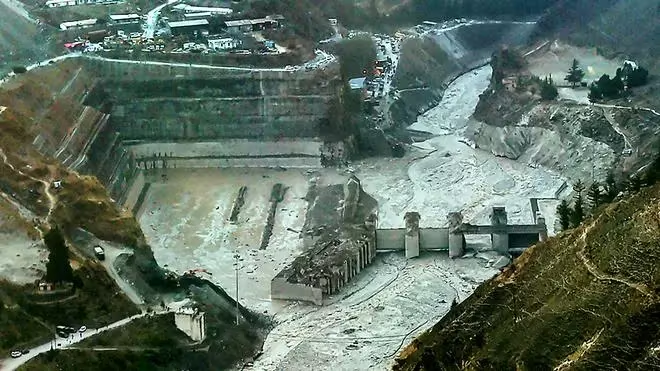
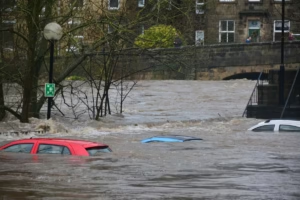
Disasters break this model. A strong quake can hit tens of thousands of buildings in one square mile at once. So can a river that bursts its banks. This clumping of risk is called correlation risk. Claims spike fast and on a huge scale. Think of many homes in one town. A flood hits them all on the same day.
Each owner files a claim at once. The pool must pay them all together. That can threaten the cash that local insurers keep in reserve.
Picture the Risk: Everyday Perils and Disaster Perils (Natural disaster policy)
These big risks also cause a problem called adverse selection. Picture flood or quake cover as an optional extra in a standard plan. Now picture that the price does not rise to match the risk. Then only owners on riverbeds, coastal plains, or active fault lines would join. Owners on high ground or firm rock would opt out. They might look for lower rates elsewhere.
This leaves the pool without its low-risk members. Their payments are what balance out the high-risk claims. Without them, the pool cannot pay. It falls apart under its own weight. In short, the exclusions protect the pool. They keep it from breaking when a disaster strikes.
Comparing Ways to Get Cover for Natural disaster policy
To protect a building well, you must know one key gap. It is the gap between a main plan and a special backup. The table below shows how each risk is handled. It shows the standard market and the special markets.
|
Risk |
Standard Property Policy (HO-3 / CP 00 10) | Special Backup Option |
Underwriting Terms |
| Burst pipe inside the building | Covered (if sudden and accidental) | Not needed. Part of the main plan. | Replacement cost value |
| Surface flood or storm surge | Not covered | NFIP or private flood insurance | Actual cash value, with strict caps |
| Earthquake shock or soil that turns to liquid | Not covered | Earthquake add-on or CEA Natural disaster policy | High percentage deductibles, such as 25% of building value |
| Landslide or sinking ground | Not covered | Difference in Conditions (DIC) Natural disaster policy | Custom excess limits and special terms |
| Windstorm or hail | Covered (except in high-risk zones) | Separate wind and hail pool (coastal zones) | – |
Notice the pattern. The main plan pays for small, sudden, local harm. The special options handle the big, wide risks.
Ways to Bridge the Gaps: Add-Ons, Stand-Alone Policies, and Parametric Cover for Natural disaster policy
Protecting a set of buildings takes many layers of risk transfer. Owners should not lean on one plan to handle all dangers. Instead, they should build a plan that fits their needs. They can use the options below.
1. NFIP and Private Flood Markets
For flood cover, owners usually choose between a federal program and the newer private market. The federal program is the National Flood Insurance Program, or NFIP. It is open to all owners in towns that take part. But its limits are low. It caps cover at $250,000 for the building of a home. It caps contents at $100,000. That may not be enough for a high-value home. If your home is worth more, you may face a gap.
Private flood insurers offer higher limits. They also give wider cover for loss of use. That means cover for the time when you cannot use your building. And they let you set the value of a loss in more flexible ways. But they look harder at how high your land sits.
2. Earthquake Add-Ons and Difference in Conditions (DIC)
You can buy Natural disaster policy in two ways. One is an add-on to your main plan. The other is a stand-alone plan from a special insurer, such as the California Earthquake Authority. These plans often set the deductible as a percentage. The percentage is taken from the total insured value of the building. It is not a fixed dollar sum. A deductible is the part of a loss that you pay first.
Large business owners can also buy a Difference in Conditions plan, Natural disaster policy or DIC. It fills the gaps that main plans leave open. It can protect against flood, quake, and earth movement. And it does so all in one big plan.
3. Modern Parametric Insurance
A newer idea is parametric insurance. Old-style insurance pays back the cost of real damage. It measures that cost after the event. A parametric contract works in a different way. It pays a fixed sum, and it pays it on its own. The payout depends on a clear trigger that is set in advance.
Here are two examples of a trigger. One is a quake that reaches a set size on the Richter scale. It must happen within a set distance of a place you name. The other is flood water that reaches a set height on a gauge.
This plan gives fast cash. You can use it for urgent needs and for costs that a deductible does not touch. There are no long steps to measure the loss. The money arrives fast, when you need it most. Each layer of cover fills a gap that the layer below it leaves open.
Look at Your Local Risk Early
Online consultancies reviews local land shape and quake risk with each client. They want to be sure your buildings do not sit on hidden fault lines. They want to be sure they are not left with no cover. Finding these gaps early helps you dodge huge losses that no one repays.
A full risk program is more than buying Natural disaster policy. It means studying building plans, site height models, and soil mechanics. It also means taking steps to prevent loss. You can install backwater valves. You can retrofit foundations with seismic tie-downs. You can keep site drainage in good shape. You can place key utilities above the base flood level. Each step lowers the harm that a flood or a quake can do.
These steps cut direct loss to your buildings. They may also help you win better rates in the secondary market. Dealing with these gaps takes steady care. Review Natural disaster policy each year. Check them against new city flood maps. Check them against updates to fault maps. Also check them against any changes to your buildings. This helps your cover keep pace with changing risks.